
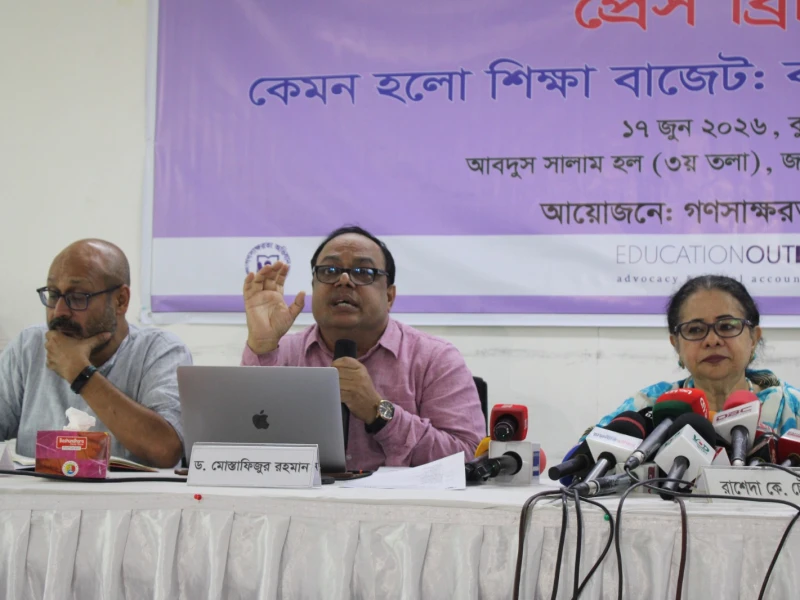
While acknowledging the record education allocation in the proposed national budget for FY2026-27, civil society organisation Campaign for Popular Education (CAMPE) on Wednesday said the increase represents an important first step toward reversing a decade-long decline but falls well short of a transformative shift needed to address the deep structural challenges facing Bangladesh's education system.
CAMPE Deputy Director Mostafizur Rahaman made the observation while presenting a paper titled ‘National Budget 2026-27: Education Sector Allocation — Are We Investing Enough for the Future?’ at a programme held at the Jatiya Press Club in the city.
The proposed education budget for FY2026-27 stands at Tk 1,22,495 crore, the highest allocation ever for the sector, reflecting a Tk 36,628 crore increase over the revised allocation of Tk 85,867 crore in FY2025-26. Education's share of GDP has risen from 1.41 percent to 1.79 percent, while its share in the national budget has increased from 10.9 percent to 13.06 percent.
However, Mostafizur pointed out that the allocation still falls significantly below UNESCO's recommended benchmark of 4–6 percent of GDP, the international norm of allocating 15–20 percent of public expenditure to education, and the current government's own electoral commitment to raise education spending to 5 percent of GDP.
The most notable feature of the budget, he said, is that the surge has been driven primarily by development expenditure, which rises by more than 153 percent, from Tk 20,750 crore in FY2025-26 to Tk 52,597 crore in FY2026-27.
But CAMPE raised a critical concern about absorption capacity. “Can the education system effectively absorb an additional Tk 31,847 crore in development spending within a single fiscal year?” Mostafizur asked, noting that total budget utilisation already fell from 90 percent in FY2024 to 85 percent in FY2025.
Among the positive signals in the budget, CAMPE highlighted free school uniforms, shoes and bags, expansion of stipend and mid-day meal programmes, one Teacher-One Tab initiative, AI training for teachers, introduction of stipends under the Technical and Madrasa Education Division, and reduction of corporate tax on private educational institutions from 15 percent to 10 percent.
On the other hand, CAMPE flagged critical gaps including the absence of a National Education Vision, lack of focus on foundational literacy and numeracy, learning recovery, regional disparities, children with disabilities, indigenous communities, and a comprehensive teacher career framework.
In its recommendations, CAMPE called for formulating a National Education Vision by 2027, removing all taxes and duties on imported educational materials, ensuring 100 percent timely release of development funds, and introducing a results-based financing framework linking expenditure to measurable learning outcomes.
For the medium term, CAMPE urged the government to adopt a legally endorsed financing roadmap to raise education expenditure to at least 6 percent of GDP and 20 percent of the national budget by 2030, and establish an Education Commission to monitor progress toward these targets.
“Bangladesh has taken an important step, but the real test will not only be how much money is allocated — it will be how effectively those resources are translated into better teachers, improved learning outcomes, reduced inequalities, and a future-ready education system,” Mostafizur said.
 Prev Post :