
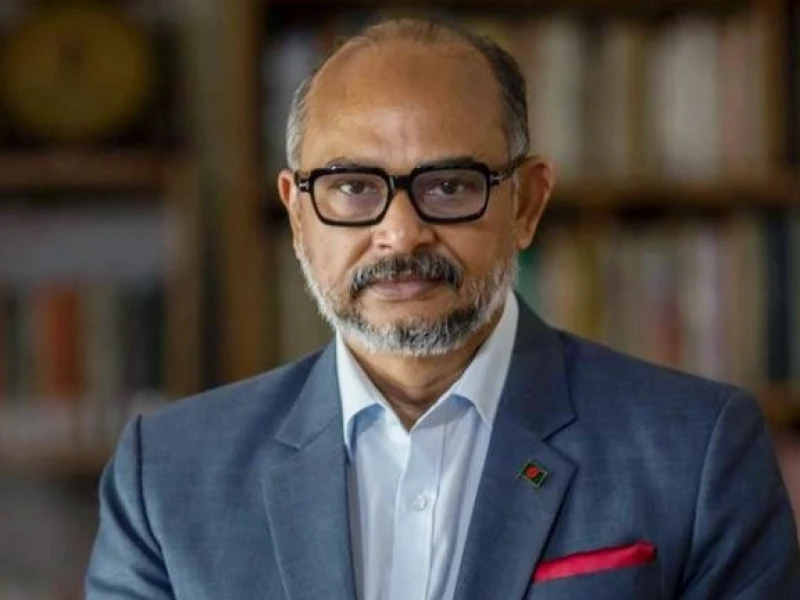
The Prime Minister’s Adviser on Finance and Planning Rashed Al Mahmud Titumir, said Wednesday that three major reform initiatives have been launched in the country’s revenue system, asserting that reducing tax evasion, tax exemptions and tax fraud would automatically boost revenue collection.
Titumir made the remarks at a post-budget dialogue on the proposed national budget for FY2026-27, jointly organised by the Metropolitan Chamber of Commerce and Industry (MCCI) and the Policy Research Institute (PRI) at the MCCI headquarters in Gulshan.
PRI Director Ahmad Ahsan presented the keynote paper titled "Macroeconomic Outlook and Budget Priorities: Stability as the Foundation for Restoring Growth" at the event. MCCI President Kamran T Rahman delivered the welcome address, while PRI Chairman Dr Zaidi Sattar and MCCI Vice President Habibullah N Karim also spoke.
Outlining the government's economic strategy, Dr Titumir said Bangladesh is pursuing a three-phase recovery plan: Recovery, Restoration, and Reconstruction for Acceleration, with emphasis on consumption, investment, public expenditure and export diversification.
On fiscal reform, he said separate task forces are now operating in the income tax, customs and VAT sectors, each guided by monthly work plans and milestone targets, with progress reviewed every month.
Titumir acknowledged that revenue data presented in the past had often not reflected ground realities, and said efforts are underway to bring greater transparency to fiscal reporting.
He warned against the growing imbalance between operational and development spending, noting that while recurrent expenditure has been rising rapidly, the ADP or capital expenditure has not kept pace, a trend he described as a long-term challenge.
Criticising the slow pace of project implementation, the adviser said the country currently has around 1,300 projects at various stages of execution, some running for 12 to 14 years with multiple revisions.
He announced plans to introduce a dashboard-based real-time monitoring system for development projects and also emphasised implementing an open data policy, saying that making BBS data and other institutional data publicly accessible would improve transparency in policymaking.
In his keynote presentation, Ahmad Ahsan described the FY2026-27 budget as “ambitious, imaginative, and broadly inclusive”, essentially a budget for everybody, but raised significant concerns about the macroeconomic framework underpinning it.
He noted that the domestic economy is exhibiting stagflationary signs, with private investment growth turning sharply negative for the first time in decades, and warned that the current slowdown is not a one-year dip but “the latest, sharpest leg of a longer downturn.”
Ahsan said the budget's revenue projections appear “out of norm,” noting that while the budget introduces several innovative tax policy measures, including mandatory TINs and BINs, turnover taxes for small businesses, quarterly e-VAT submissions and duty reductions on solar, EVs and semiconductors, it lacks high-impact reforms such as a unified VAT rate or a reduction in tax expenditures that could significantly improve compliance.
On foreign financing, he said the FY2026-27 budget targets a gross external inflow of Tk 1,558 billion, some 89 percent above what FY2025-26 actually delivered, calling the projection overly optimistic given fiscal stress in high-income countries and the FY26 pattern of significant underperformance against targets.
Ahsan urged the government to prepare a credible “Plan B”, a mid-term revised budget, with a clearly prioritised core expenditure package to be protected if revenues and foreign financing fall short.
The PRI paper flagged major unrecognised contingent liabilities in the energy and banking sectors. Ahsan said the budget's Strategic Energy Reserve carries no costed target and zero funding, while off-budget fuel import exposure through BPC and Petrobangla, estimated at around USD 12 billion annually, remains entirely outside the fiscal framework.
On banking, he said the 2026 asset quality reviews put the true contingent liability at Tk 7.40 lakh crore, roughly 13.7 percent of GDP and about 18 times the Tk 40,000 crore allocated for bank recapitalisation this year, with no costed multi-year resolution framework in the budget.
Ahsan also called for addressing Bangladesh’s persistent anti-export bias, particularly in light engineering, agro-processing, pharmaceuticals and leather goods, noting that the bias is worst exactly where diversification is most needed.
He drew comparisons with Vietnam's success in attracting export-oriented FDI as a model Bangladesh should emulate.
On public spending, he stressed the need to strengthen expenditure monitoring institutions, including giving the Implementation Monitoring and Evaluation Division (IMED) real enforcement powers, modernising BBS data systems, and cutting the roughly eight-month lag in monthly fiscal reporting to enable mid-year course correction.
He also proposed a public works programme targeting light infrastructure, upazila and rural roads, canal cleaning and sewage clearance to generate productive employment for several hundred thousand workdays while yielding strong economic returns.
 Prev Post :