
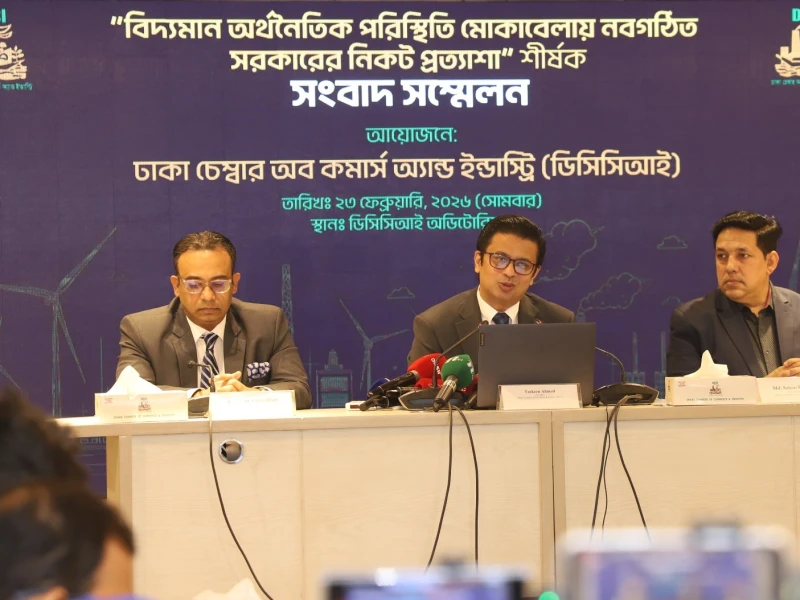
High bank lending rates, unstable law and order marked by extortion, energy uncertainty and lack of coordination in revenue management are proving “suicidal” for the economy, President of the Dhaka Chamber of Commerce & Industry (DCCI) Taskeen Ahmed said on Monday.
Taskeen made the remarks at a press conference titled “Expectations from the New Government to Address the Current Economic Situation” held at the DCCI auditorium in the city.
Taskeen said the unchanged policy rate has forced businesses to borrow from banks at 16–17 percent interest, creating mounting pressure on the private sector. “The high volume of non-performing loans (NPLs) and the reduction of the loan classification period from nine months to three months have further destabilised the financial sector.”
“Industrial production is being hampered due to inadequate gas supply and the recent increase in gas prices for new industries and captive power plants by Tk 40 and Tk 42 per unit respectively,” he said, noting that both domestic demand and export targets are being missed as a result.
He warned that the absence of policy continuity in industrial regulations and an “unbearable” level of extortion have eroded investor confidence, affecting both local and foreign investments.
The DCCI president also pointed to structural weaknesses in the revenue management system, saying the lack of automation leads to harassment of compliant taxpayers while many remain outside the tax net, depriving the government of due revenue and slowing collection growth.
Taskeen said delays in land acquisition, high land prices, a 41 percent average increase in service charges by the Chattogram Port Authority and underutilisation of inland waterways have significantly raised the cost of doing business. “Rising production and distribution costs are also fuelling inflationary pressures.”
On Bangladesh’s graduation from the least developed country (LDC) status, Taskeen said estimates by United Nations Conference on Trade and Development (UNCTAD) suggest exports could decline by 5.5–7 percent, equivalent to around $2.7 billion.
Given the current domestic and global economic uncertainties, such a setback would be highly undesirable, he said, urging the government to seek at least a three-year deferment of LDC graduation.
Referring to the recently signed agreement with the United States, he said it does not guarantee duty-free access for the ready-made garment sector, while conditions related to LNG and other imports may increase business costs. He called on the government to renegotiate the terms with the US administration.
During the question-and-answer session, the DCCI president stressed the need for effective measures to curb extortion and improve law and order.
He noted that over two million educated youths remain unemployed, warning that prolonged joblessness could lead to social instability.
He emphasised strengthening skill development programmes, simplifying business procedures and ensuring easier access to bank loans—particularly for young entrepreneurs and startups.
DCCI Senior Vice President Razeev H Chowdhury, Vice President Md. Salem Sulaiman and members of the Board of Directors were present at the event.
 Prev Post :