
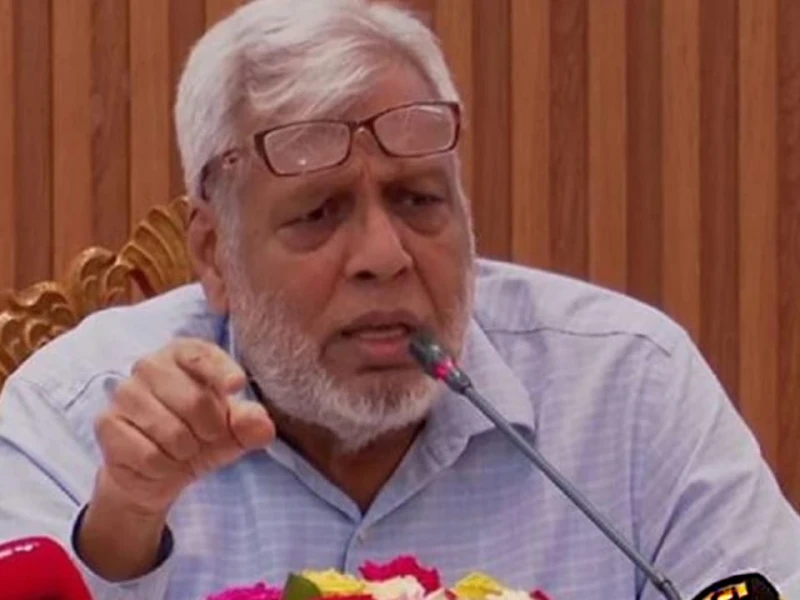
Retailers and wholesalers have manipulated the market to hike liquefied petroleum gas (LPG) prices, Power, Energy and Mineral Resources Adviser Fouzul Kabir Khan said on Tuesday.
He made the remarks while talking to reporters after a meeting of the Advisory Committee on Government Purchase and Economic Affairs at the Secretariat.
Fouzul Kabir said some traders had anticipated a price increase following a recent adjustment by the Bangladesh Energy Regulatory Commission (BERC) and took advantage of the situation by artificially raising prices. “Those who expected LPG prices to go up tried to exploit it,” he said.
He added that the Cabinet Secretary has been instructed to conduct mobile courts in every district to deal with the issue. The matter was also discussed at a recent law and order advisory committee meeting, he said, noting that the abnormal price hike was the result of deliberate manipulation.
When asked who were involved, the adviser said retailers and wholesalers acted together to manipulate LPG prices.
Mobile courts are already operating against traders involved in abnormal price hikes, he said, adding that steps are also being taken to reopen shops that were kept closed deliberately.
Replying to a question on whether those involved have been punished, Fouzul Kabir said penalties have been imposed in many cases. “Three agencies are working on this—district administrations under the Cabinet Secretary, the police, and the Directorate of National Consumer Rights Protection,” he said, adding that fines imposed on traders have been reported in the media.
He said government teams are being deployed across the country, including in Chattogram and Dhaka, to ensure LPG prices return to normal. “People are being held hostage, and we will do everything necessary to normalise the situation,” he said.
Regarding allegations that advance information about LPG price hikes was leaked from BERC, the adviser said the government would investigate whether anyone from the regulatory body was involved.
Fouzul Kabir noted that around 98 percent of the LPG market is operated by the private sector, while only about 2 percent comes from state-owned sources, mainly using propane and butane from Eastern Refinery.
He said discussions were first held with the Energy Secretary and the BERC chairman, followed by a meeting between the Energy Secretary and the LPG Operators Association of Bangladesh. According to the meeting, LPG imports were higher this month compared to last month, meaning there should be no supply shortage.
The adviser said a temporary price spike had occurred but expressed hope that prices would gradually come down.
He also mentioned that some shipping restrictions have created logistical challenges, but stressed that there is no immediate risk of disruption this month. “We are monitoring the situation to prevent any future shipping-related problems,” he said.
On the ongoing gas supply issues in households, Fouzul Kabir said domestic gas production and LNG imports remain adequate. “This is not a supply shortage. During winter, pipeline-related technical issues affect gas pressure, which causes temporary disruption,” he explained, adding that LNG imports are continuing as planned and even increasing.
-1767631588.webp) Prev Post :
Prev Post :