
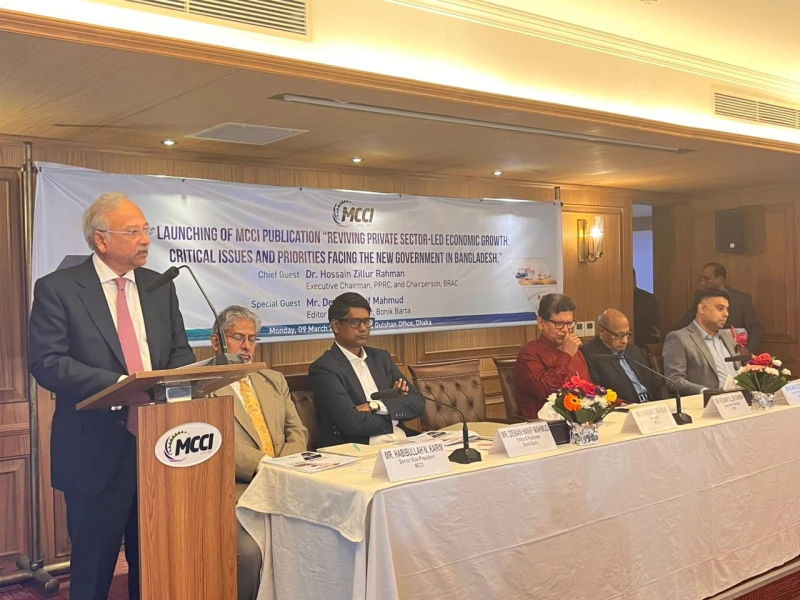
Reviving private sector-led growth will be critical for restoring Bangladesh’s economic momentum and ensuring sustainable development, according to a new policy report launched on Monday by the Metropolitan Chamber of Commerce and Industry (MCCI).
Titled “Reviving Private Sector-led Economic Growth: Critical Issues and Priorities Facing the New Government in Bangladesh,” the publication was presented by M Masrur Reaz, Chairman and CEO of Policy Exchange Bangladesh, at a programme organised by MCCI.
The report provides an evidence-based assessment of Bangladesh’s current economic challenges and outlines a set of reform priorities aimed at restoring macroeconomic stability, strengthening investment climate, and enabling sustainable growth driven by the private sector.
Speaking at the launch, Reaz said Bangladesh stands at a “critical juncture” as the economy transitions from crisis management to recovery amid persistent structural constraints and global uncertainty.
He noted that although the country experienced decades of strong growth averaging around 6–7 percent, economic momentum has slowed significantly since 2022 due to a combination of global shocks, domestic policy weaknesses and institutional challenges.
According to the report, Bangladesh’s GDP growth has dropped to below 4 percent in FY2025, while inflation, declining private investment and tightening credit conditions have continued to weigh on business confidence and economic activity.
The study highlights that structural weaknesses in public finance, the banking sector, export competitiveness and the investment climate are undermining the country’s growth prospects. Without comprehensive reforms, these vulnerabilities could push the economy toward prolonged stagnation, it warned.
The report identifies seven priority areas for policy reform to revive private sector-led growth. These include macroeconomic stabilisation, fiscal management and debt sustainability, banking sector reforms, export diversification, private investment mobilisation, energy security, and skills development.
It also stresses that restoring macroeconomic stability should be the immediate priority for policymakers. The study recommends tighter monetary and fiscal coordination, improved revenue mobilisation, and a more flexible exchange rate regime to stabilise inflation and rebuild foreign exchange reserves.
In the financial sector, the report highlights the urgent need to address rising non-performing loans and governance weaknesses in banks, warning that these issues are constraining credit flows and discouraging private investment.
Export diversification is another key challenge identified in the report. While Bangladesh’s export sector remains heavily dependent on ready-made garments, the report calls for targeted policies to develop new high-potential sectors and strengthen global value chain integration, particularly as the country prepares for its post-LDC transition.
To boost investment, the study recommends improving regulatory predictability, modernising business-related laws and strengthening the investment promotion framework to attract both domestic and foreign investors.
The report also emphasises the importance of energy sector reforms to ensure reliable and affordable power supply for businesses, as well as expanding skill development programmes to create a future-ready workforce capable of supporting productivity growth and job creation.
MCCI leaders said the report aims to provide policymakers with a comprehensive reform roadmap to restore economic confidence and enable Bangladesh to move toward a more resilient and competitive growth model.
The initiative was undertaken by MCCI with Policy Exchange Bangladesh serving as the research partner under the overall guidance of MCCI President Kamran T Rahman and Secretary General Farooq Ahmed.
They expressed hope that the policy recommendations outlined in the study would help the new government prioritise reforms needed to revive private sector-led growth and sustain Bangladesh’s development trajectory in the coming years.
 Prev Post :