Road accidents across Bangladesh claimed 402 lives and left 1,294 others injured in 394 separate incidents during the Eid-ul-Azha travel period this year, according to the Jatri Kalyan Samity.
Including rail and waterway accidents, the total casualty count rises sharply 442 incidents across all transport modes killed 438 people and injured 1,340 others during the 15-day period from May 21 to June 4. Rail accidents accounted for 23 deaths and 30 injuries in 31 incidents, while 17 waterway accidents killed 13 and injured 16.
Compared to last year's Eid-ul-Azha, road accidents rose 3.95 percent, fatalities increased 3.07 percent, and injuries jumped 9.47 percent. In 2025, 379 road accidents had killed 390 people and injured 1,182 during the same festive period.
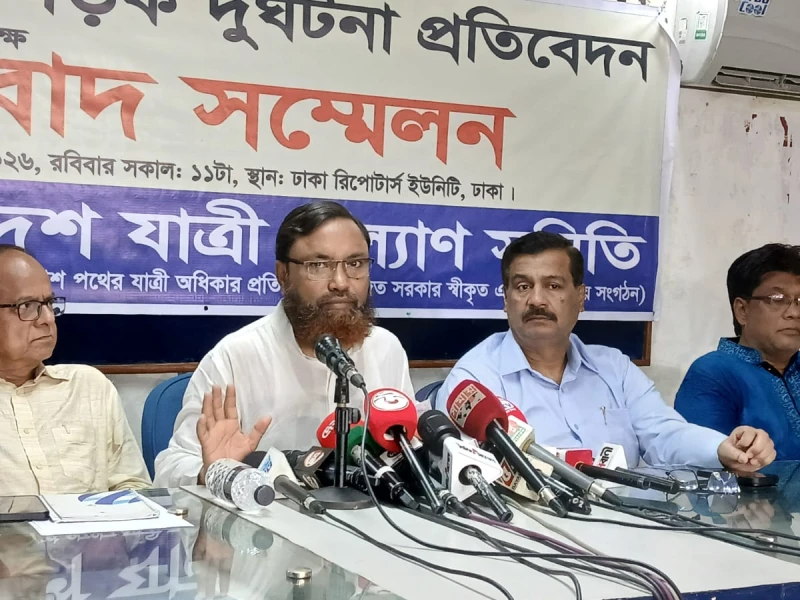
Jatri Kalyan Secretary General Md Mozammel Haq Chowdhury presented the findings at a press conference at the Dhaka Reporters’ Unity on Sunday morning, calling for urgent structural reforms to the country's public transport system.
“What is needed is not 10 to 12 days of government activity around Eid, but short, medium and long-term planning to save lives and reduce travel misery,” he said, stressing the need for a modern bus network modelled on developed countries, technology-based road management, and the gradual removal of small vehicles from highways.
Motorcycles top the casualty list
Motorcycles were once again the deadliest vehicle category, involved in 153 accidents that killed 159 people and injured 180, accounting for 38.83 percent of all road accidents during the period.
In terms of vehicle types involved across all accidents, motorcycles made up 28.90 percent, followed by trucks and covered vans at 21.40 percent, buses at 16.56 percent, battery-powered rickshaws at 12.34 percent, cars and microbuses at 7.81 percent, locally-made light vehicles (noshimon-korimmon) at 6.56 percent, and CNG-run auto-rickshaws at 6.40 percent.
Among those killed or injured, 80 were drivers, 89 transport workers, 59 pedestrians, 64 women, 45 children, and 66 students. Three journalists, one doctor, one engineer, and five law enforcement members were also among the victims.
Analysis of accident types shows that 46.44 percent were head-on collisions, 29.18 percent involved vehicles running over pedestrians or ramming others, and 17.25 percent involved vehicles losing control and falling into ditches or off roads. Train-vehicle collisions accounted for 1.52 percent, with the remaining 5.58 percent attributed to other or unidentified causes.
Half of all accidents, 50.50 percent occurred on national highways, 30.71 percent on regional highways, and 14.46 percent on feeder roads. Within city areas, 2.53 percent occurred in Dhaka and 0.25 percent in Chattogram. Some 1.52 percent took place at railway crossings.
Jatri Kalyan identified several systemic causes behind this year's toll: unregulated movement of motorcycles and battery-powered vehicles on national highways; absence of road signs, lane markings, and streetlights; roads riddled with potholes following rain; a severe driver shortage forcing 80 percent of vehicles to operate continuously with a single driver; defective and life-expired buses being pushed into service by profit-seeking owners; and low-income passengers being forced onto bus rooftops or cargo trucks due to exorbitant fares.
The association urged the government to develop and implement short, medium, and long-term road safety plans; modernise the vehicle fitness certification system; remove expired public transport; expand BRTA's enforcement capacity; establish a traffic training academy; and end the monopoly control of bus owner associations and worker federations over the transport sector.
The press conference was also attended by former government secretary Dr AYM Ekramul Haq and other senior Jatri Kalyan officials.
 Prev Post :